
Your home insurance deductible is the single dial with the biggest, fastest effect on your premium—one choice can swing your annual cost by hundreds of dollars. Yet most homeowners pick it once and never think about it again. Here are 7 proven tips to choose the right one, with real dollar numbers. Run your numbers through a home insurance calculator as you read.
home insurance deductible: the 30-second explainer
The deductible is what you pay out of pocket on a covered claim before the insurer pays the rest. Three things people get wrong:
- It is per claim, not per year. Every new claim carries its own deductible.
- You pay it to the contractor, not the insurance company. The insurer simply subtracts it from your payout.
- Liability and medical-payments coverages carry no deductible. Only the property coverages (dwelling, personal property, other structures) do.
Tip 1: Run the 4-Tier Dollar Comparison
Forget savings “ranges”—here is what each tier costs on the same $2,490 baseline premium:
| Deductible | Premium impact | Annual premium | Monthly |
|---|---|---|---|
| $500 | +15% vs baseline | $2,863.50 | $238.63 |
| $1,000 | Baseline | $2,490.00 | $207.50 |
| $2,500 | −18% vs. baseline | $2,041.80 | $170.15 |
| $5,000 | −28% vs. baseline | $1,792.80 | $149.40 |
The jump from $500 to $5,000 saves $1,070.70 a year—but only if you can actually produce $5,000 when disaster strikes.
Tip 2: Do the Break-Even Math
A higher deductible only pays off if you go claim-free long enough for the savings to cover the extra out-of-pocket. The payback periods:
- $500 → $1,000: saves $373.50/yr → pays back in 1.3 claim-free years
- $1,000 → $2,500: saves $448.20/yr → pays back in 3.3 claim-free years
- $1,000 → $5,000: saves $697.20/yr → pays back in 5.7 claim-free years
The industry’s 3-year rule: if the savings recover the deductible increase within 3 years, raise it. Three to five years—think it over. Over five years, it is probably not worth the risk—and the average homeowner files a claim roughly every 7 years.
Tip 3: Never Exceed Your Emergency Fund
This is the hard rule: your deductible must be money you can produce within 30 days of a disaster. A $5,000 deductible with $1,200 in savings is not a strategy—it is a gamble. If the roof fails in a storm and you cannot cover the deductible, the claim stalls and the damage gets worse.
Set the deductible at or below your liquid emergency fund, then rebuild the fund. Only raise the deductible after the savings are real.
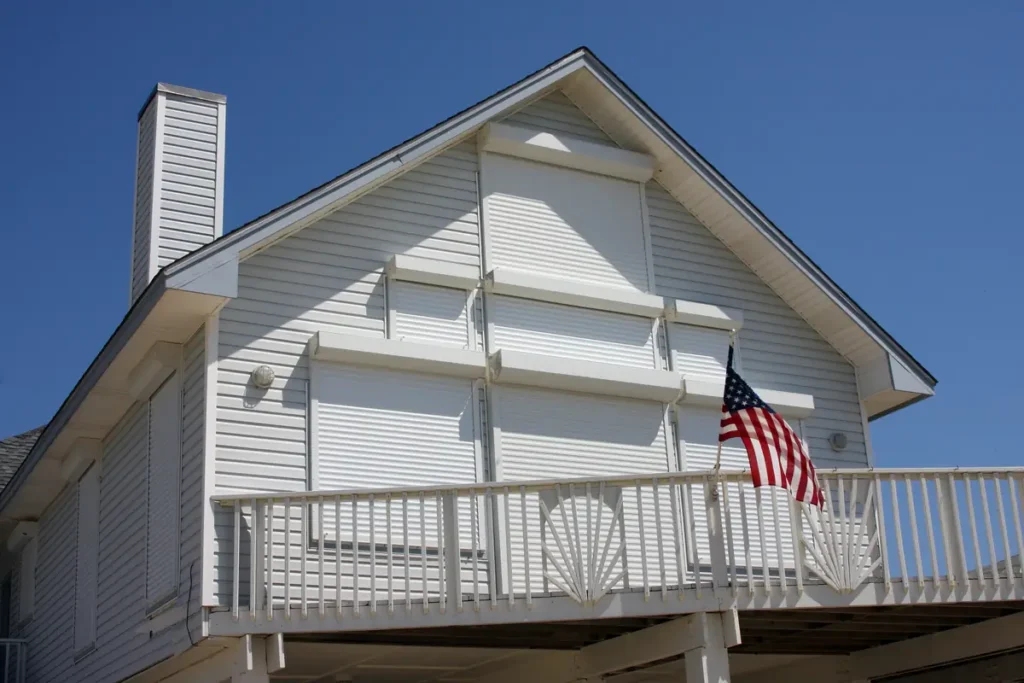
Tip 4: Watch Out for Hurricane Percentage Deductibles
In coastal states (Florida, Texas, Louisiana, and other Gulf/Atlantic states), wind and hail damage often carries a percentage deductible—1% to 5% of your dwelling coverage—instead of a flat dollar amount:
2% of $350,000 = $7,000 out of pocket before your insurer pays a cent
5% of $350,000 = $17,500
This is the deductible that shocks people. Check your policy’s declarations page now—if you live near the coast, you may have two deductibles and not know it. Store dated damage photos, receipts, and policy documents in Google Drive as free claim evidence.
Tip 5: Check Your Lender’s Deductible Limit
If you have a mortgage, your lender can cap your deductible—many limit it to $1,000 or $2,500 because a deductible you cannot afford puts their collateral at risk. This matters most before closing: Confirm the limit with your loan officer so your policy is not rejected at the last minute. After closing, rerun the break-even math—the savings from a higher deductible may justify staying at the cap.
Tip 6: Know Which Coverages Skip the Deductible
No deductible applies to:
- Personal liability—if someone is injured on your property, coverage starts at dollar one.
- Medical payments to others—guests’ minor injuries, no deductible.
But watch for special deductibles hiding in the fine print: some policies carry a separate, higher deductible for water damage (often $5,000)—a nasty surprise when a pipe bursts. Read the exclusions and endorsements page once; it is the cheapest insurance you will ever buy.
Tip 7: Revisit Your Deductible Every Year
Your deductible should move with your life: a bigger emergency fund, a new roof, kids leaving for college, a paid-off mortgage—all change the math. Write down your deductible choice and review date in a free Google Doc and revisit it at every renewal. The $500 deductible that made sense when you were cash-tight at closing may be costing you $373.50 a year too much today.
What is a good home insurance deductible?
$1,000 suits most homeowners. Choose $500 if cash is tight, or $2,500+ once you have a solid emergency fund that covers it.
Is it better to have a $500 or $1,000 deductible?
$1,000—if you can cover it. On a $2,490 premium it saves about $373.50 a year and pays for itself in 1.3 claim-free years.
Do I pay my deductible to the insurance company?
No. You pay it to the contractor doing the repairs—the insurer subtracts it from your claim payout.
Does the deductible apply per claim or per year?
Per claim (per event). Every new claim carries its own deductible; there is no annual cap that absorbs them.
What is a hurricane deductible?
A separate 1–5% dwelling-coverage deductible for wind/hail damage in coastal states. At 2% of $350,000, that is $7,000 out of pocket.
Can my lender limit my deductible?
Yes. Many mortgage lenders cap the deductible (often $1,000–$2,500). Confirm with your loan officer before closing.
Final Thoughts
The right deductible is a personal number, not a universal one: run the 4-tier comparison, check the break-even years, keep it under your emergency fund, and watch for percentage deductibles on the coast. Revisit it yearly. Ten minutes of math here saves hundreds every year—and prevents the worst surprise in insurance, a deductible you cannot afford when you need it most.
Disclaimer: Deductible figures in this article are general education based on typical US homeowners policies—not policy language. Actual deductibles, savings, and rules vary by insurer and state. Your policy document controls; confirm details with a licensed insurance agent.